How often to water blue fescue in California
In July in the Central Valley, established blue fescue needs about 0.8 gallons a week for a plant 2 feet across. Blue fescue is a small, clumping, cool-season grass from southern Europe, forming tidy domes of fine, blue-gray blades under a foot tall. Purple-tinged flower sprays rise above it in late spring and early summer. It is fairly short-lived and tends to brown in hot summer sun. It tolerates drought once established but hates wet, poorly drained soil.
How often to water blue fescue, month by month
Type your city above and the days between waterings and the gallons appear here, worked out from your city's climate table. Or read the figures by climate zone further down.
How this is worked out: the plant’s WUCOLS rating times your city’s climate for the month, over the area the plant covers. Skip a watering after a good soaking rain.
How to tell it needs water
- Blue fescue blades turning dull and folding while the soil is dry a couple of inches down mean it needs water
- Browning in the hottest part of summer is a heat response, not always thirst
- A clump dying out in the center points to age and a need to divide
- Rotting at the base in soggy soil points to overwatering
How to water it
- Water at the base when the top couple of inches of soil dry
- Plant in full sun on the coast and give it afternoon shade inland
- Use well-drained soil, and avoid low, wet spots
- Comb or trim the clumps during the cooler months to keep them neat
- Divide and replant clumps when the centers die out
Through the seasons
Water new clumps regularly until roots take hold. Established plants are drought tolerant on the coast and in the valleys, though they may turn brown in the hottest part of summer. As a cool-season grass, it grows most in fall and spring. It keeps its blue color through mild winters. WUCOLS rates blue fescue low water on the north-central coast, in the Central Valley, on the south coast and in South Inland. The high desert and the low desert each carry a moderate water rating.
In pots
Blue fescue looks sharp in a low bowl or as edging in a mixed container. Use a gritty, well-drained mix. Water when the top inch or two dries, then let it drain fully. In summer, check every couple of days and give afternoon shade inland. Keep the saucer empty, since wet roots rot quickly. Trim old blades in the cool season. In winter, water only when the mix dries.
- A year
- 6.84 gal per sq ft
- Reference
- Sacramento climate table
- Counts
- Plant need, before sprinkler losses
Monthly water need by climate zone
Blue Fescue: gallons per square foot per month, by WUCOLS climate zone
| Month | N. Coast | C. Valley | S. Coast | S. Inland | Hi Desert | Lo Desert |
|---|---|---|---|---|---|---|
| Jan | 0.15 | 0.16 | 0.31 | 0.31 | 0.74 | 0.78 |
| Feb | 0.21 | 0.26 | 0.32 | 0.35 | 0.93 | 0.93 |
| Mar | 0.35 | 0.43 | 0.46 | 0.52 | 1.46 | 1.52 |
| Apr | 0.47 | 0.61 | 0.56 | 0.64 | 1.89 | 1.95 |
| May | 0.58 | 0.83 | 0.64 | 0.78 | 2.39 | 2.45 |
| Jun | 0.64 | 0.99 | 0.69 | 0.92 | 2.85 | 2.79 |
| Jul | 0.64 | 1.07 | 0.79 | 1 | 3.04 | 2.85 |
| Aug | 0.6 | 0.95 | 0.74 | 0.93 | 2.79 | 2.6 |
| Sep | 0.5 | 0.72 | 0.6 | 0.74 | 2.14 | 2.08 |
| Oct | 0.35 | 0.47 | 0.46 | 0.53 | 1.46 | 1.49 |
| Nov | 0.19 | 0.22 | 0.33 | 0.36 | 0.93 | 0.96 |
| Dec | 0.12 | 0.14 | 0.26 | 0.27 | 0.65 | 0.68 |
| Year | 4.8 | 6.84 | 6.2 | 7.37 | 21.27 | 21.08 |
How this is worked out: the WUCOLS water rating for each zone times that zone’s climate for the month. A dash means WUCOLS does not rate the plant there. The figures are what the plant uses, before sprinkler losses.
Plants with the same water needs 6
Rated low water in the Central Valley, like blue fescue. Plants that drink alike can share one valve and one schedule.
 Quaking GrassBriza medialow water, Central Valley1.07 gal/sq ft in July
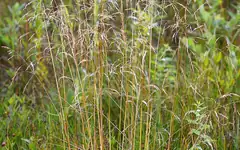 Tufted HairgrassDeschampsia cespitosa and cvs.low water, Central Valley1.07 gal/sq ft in July
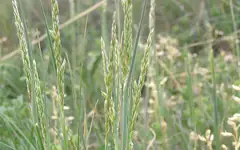 June GrassKoeleria macrantha (cristata)low water, Central Valley1.07 gal/sq ft in July
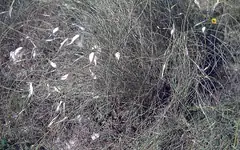 False Esparto GrassLygeum spartumlow water, Central Valley1.07 gal/sq ft in July
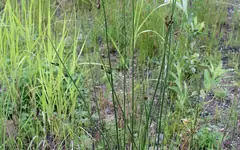 Baltic RushJuncus balticuslow water, Central Valley1.07 gal/sq ft in July
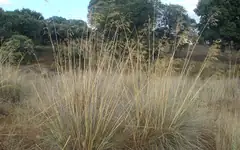 Giant Needle GrassStipa gigantealow water, Central Valley1.07 gal/sq ft in July
Turn this into minutes on your water days
Every city page has a calculator that takes blue fescue, your sprinkler type and the month, and gives the minutes per water day for that supplier's schedule. Or put it in a zone of the personal watering plan and get all twelve months printed.
Questions people ask
How much should I water blue fescue in summer?
In July, established blue fescue needs about 0.8 gallons in the Central Valley, 0.6 gallons on the south coast and 0.7 gallons in the South Inland zone each week, for a plant 2 feet across. Water deeply and let the top of the soil dry before the next watering. Skip a watering after a soaking rain.
How much water does blue fescue need per day?
In July in the Central Valley, established blue fescue needs about 0.1 gallons a day for a plant 2 feet across and about 0.4 gallons a day for a plant 4 feet across. Give it in deep waterings spread days apart rather than a little every day, so the whole root zone gets wet.
Does watering for blue fescue change across California?
Yes. WUCOLS rates blue fescue separately for each of the six California climate zones: low water in the North-Central Coastal zone, low water in the Central Valley zone, low water in the South Coastal zone, low water in the South Inland zone, moderate water in the High and Intermediate Desert zone, moderate water in the Low Desert zone. The monthly table above shows how the same rating translates into different gallon amounts as reference evapotranspiration changes.
Why is my blue fescue turning brown?
It tends to brown in hot summer sun and in severe winter weather. Old clumps also die out in the center. Shade it from hot afternoon sun inland.
How long does blue fescue live?
It is fairly short-lived. Clumps often need dividing or replacing after two or three years. Replant healthy outer pieces.
Should I cut back blue fescue?
Trim it during the cooler months to keep it neat. Comb out dead blades by hand at the same time.
Can blue fescue grow in shade?
It prefers full sun but tolerates some part shade. Inland, afternoon shade prevents burning. Good drainage matters in any light.
What are good blue fescue varieties?
'Elijah Blue' is a silvery blue form under a foot tall that is noted for heat tolerance, though it can still brown in hot sun. 'Azurit' is a little larger and less silvery. Both need good drainage.
Is blue fescue drought tolerant?
Yes, once established it tolerates drought and poor soil. It is intolerant of wet, poorly drained soil. Water deeply but not often.
More plant watering guides
Sources
- WUCOLS IV plant water use classification for Festuca glauca ssp. & cvs., the University of California survey California agencies use for landscape plan reviewRead August 23, 2026 on wucols.ucdavis.edu
- Model Water Efficient Landscape Ordinance, adopted text and appendices, effective 2025-01-02 · monthly reference evapotranspiration per city, Appendix CRead August 23, 2026 on water.ca.gov/-/media/DWR-Website/Web-Pages/Programs/Water-Use-And-Efficiency/MWELO-Rulemaking/Final-MWELO-Text-and-Appendices_20250103.pdf
- UC Statewide IPM Program, irrigation scheduling using evapotranspirationRead September 30, 2026 on ipm.ucanr.edu/PMG/GARDEN/ENVIRON/evap.html
- Shaw and Pittenger, Landscape Irrigation System Evaluation and Management, UC Cooperative Extension, 2009Read September 30, 2026 on ucanr.edu/sites/default/files/2013-02/160836.pdf
- Pittenger, Water Management in Gardens and Landscapes, UC Riverside, 2017Read September 30, 2026 on ucanr.edu/sites/default/files/2017-03/258022.pdf