How often to water shrub cotoneaster in California
In July in the Central Valley, established shrub cotoneaster in loam needs a deep watering about every 20 days: about 8.8 gallons each time for a plant 4 feet across, about 3.0 gallons a week. Shrub cotoneasters range from stiff upright plants to fountains of arching branches. Some species are evergreen, some semievergreen and some drop their leaves in fall. Small spring flowers give way to long-lasting red or orange berries. Established plants need little water where summers are mild, while hot inland summers call for some irrigation.
How often to water shrub cotoneaster, month by month
Type your city above and the days between waterings and the gallons appear here, worked out from your city's climate table. Or read the figures by climate zone further down.
How this is worked out: established roots fill the top 1.5 feet of soil, and you water again when that soil has dried halfway. Loam soil holds about 1.5 inches of water per foot. Water the whole area the plant covers, and skip a watering after a good soaking rain.
How to tell it needs water
- Dry soil 3 to 4 inches deep beneath the outer branches tells you an inland cotoneaster wants a deep soak
- Leaves that hang dull and limp into the next morning, with dry soil below, point to a root zone that has run dry
- Fine pale stippling and webbing on the leaves point to spider mites, one of the pests UC lists on cotoneaster
- Flowers, shoots and leaves that turn black and cling to the branch are fire blight, which water will not cure
- Sudden browning over soil that stays wet, or clusters of honey colored mushrooms at the base, point to root rot from too much water
How to water it
- Water a shrub cotoneaster at the soil under its outer branches with drip or a slow hose, not with spray over the foliage
- Soak to a depth of about a foot, then hold off until the upper few inches have dried out
- Keep sprinkler spray off the plant while it is in bloom, since water droplets carry fire blight bacteria to the flowers
- Plant in well-drained soil in full sun, and keep the base of the stems dry through summer
- Move emitters outward as the branches spread, and mulch the root zone a few inches back from the stems
Through the seasons
The first summer after planting calls for deep soakings, while the roots grow out beyond the planting hole. Once settled, it gets by on little water where summers are mild. Spring brings the flowers, and the berries color up from late summer and can last into winter. Evergreen kinds keep their foliage, while deciduous ones stand leafless through winter. WUCOLS rates shrub cotoneaster low water on the north-central coast, in the Central Valley and on the south coast. There, winter rain carries it through the cool months. It rates moderate water in South Inland, the high desert and the low desert, where summer soil checks matter more. Through long dry spells in winter, check the soil in both deserts too.
In pots
A compact cotoneaster can spend some years in a large container, but the big arching kinds outgrow a pot quickly. Through summer, push a finger 2 inches into the mix every few days, and test more often in South Inland and desert heat. Give each watering enough to flow out the bottom holes, then pour off the saucer so the roots are never left standing in water. Hot paving makes a pot dry much faster than garden soil, so lift it off the pavement or shade the container. In winter, add water only once the mix is dry beneath the surface.
- A year
- 6.84 gal per sq ft
- Reference
- Sacramento climate table
- Counts
- Plant need, before sprinkler losses
Monthly water need by climate zone
Shrub Cotoneaster: gallons per square foot per month, by WUCOLS climate zone
| Month | N. Coast | C. Valley | S. Coast | S. Inland | Hi Desert | Lo Desert |
|---|---|---|---|---|---|---|
| Jan | 0.15 | 0.16 | 0.31 | 0.78 | 0.74 | 0.78 |
| Feb | 0.21 | 0.26 | 0.32 | 0.87 | 0.93 | 0.93 |
| Mar | 0.35 | 0.43 | 0.46 | 1.3 | 1.46 | 1.52 |
| Apr | 0.47 | 0.61 | 0.56 | 1.61 | 1.89 | 1.95 |
| May | 0.58 | 0.83 | 0.64 | 1.95 | 2.39 | 2.45 |
| Jun | 0.64 | 0.99 | 0.69 | 2.29 | 2.85 | 2.79 |
| Jul | 0.64 | 1.07 | 0.79 | 2.51 | 3.04 | 2.85 |
| Aug | 0.6 | 0.95 | 0.74 | 2.33 | 2.79 | 2.6 |
| Sep | 0.5 | 0.72 | 0.6 | 1.86 | 2.14 | 2.08 |
| Oct | 0.35 | 0.47 | 0.46 | 1.33 | 1.46 | 1.49 |
| Nov | 0.19 | 0.22 | 0.33 | 0.9 | 0.93 | 0.96 |
| Dec | 0.12 | 0.14 | 0.26 | 0.68 | 0.65 | 0.68 |
| Year | 4.8 | 6.84 | 6.2 | 18.41 | 21.27 | 21.08 |
How this is worked out: the WUCOLS water rating for each zone times that zone’s climate for the month. A dash means WUCOLS does not rate the plant there. The figures are what the plant uses, before sprinkler losses.
Plants with the same water needs 16
Rated low water in the Central Valley, like shrub cotoneaster. Plants that drink alike can share one valve and one schedule.
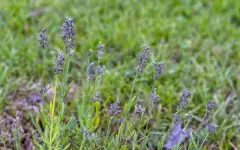 LavenderLavandula spp. & cvs.low water, Central Valley1.07 gal/sq ft in July
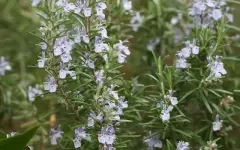 RosemaryRosmarinus officinalislow water, Central Valley1.07 gal/sq ft in July
 BougainvilleaBougainvillea & spp. & cvs.low water, Central Valley1.07 gal/sq ft in July
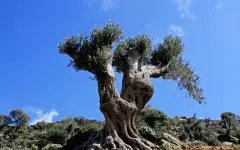 Olive TreesOlea europaea ssp. & cvs.low water, Central Valley1.07 gal/sq ft in July
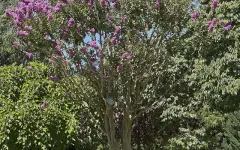 Crape MyrtleLagerstroemia spp., hybrids & cvs.low water, Central Valley1.07 gal/sq ft in July
 LantanaLantana camara ssp. & cvs.low water, Central Valley1.07 gal/sq ft in July
 SalviaSalvia greggii ssp., cvs. & hybridslow water, Central Valley1.07 gal/sq ft in July
 AloeAloe spp. & cvs.low water, Central Valley1.07 gal/sq ft in July
 SucculentsEcheveria spp. & cvs.low water, Central Valley1.07 gal/sq ft in July
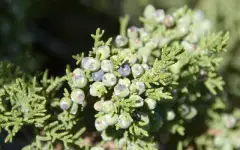 JunipersJuniperus spp. & cvs.low water, Central Valley1.07 gal/sq ft in July
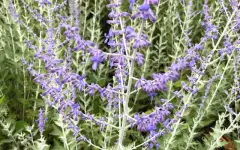 Russian SagePerovskia spp. & cvs.low water, Central Valley1.07 gal/sq ft in July
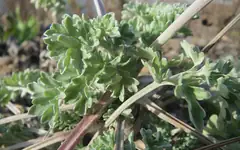 SagebrushArtemisia spp. (shrubby)low water, Central Valley1.07 gal/sq ft in July
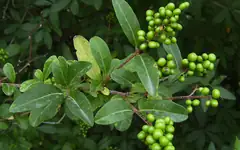 Wild PrivetLigustrum vulgarelow water, Central Valley1.07 gal/sq ft in July
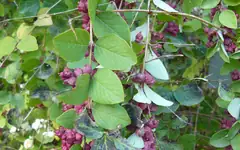 CoralberrySymphoricarpos orbiculatus (SHADE)low water, Central Valley1.07 gal/sq ft in July
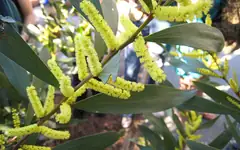 Sydney Golden WattleAcacia longifolialow water, Central Valley1.07 gal/sq ft in July
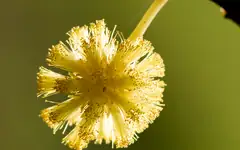 Blue Leaf WattleAcacia salignalow water, Central Valley1.07 gal/sq ft in July
Turn this into minutes on your water days
Every city page has a calculator that takes shrub cotoneaster, your sprinkler type and the month, and gives the minutes per water day for that supplier's schedule. Or put it in a zone of the personal watering plan and get all twelve months printed.
Questions people ask
How often should I water shrub cotoneaster in summer?
In July, established shrub cotoneaster in loam needs a deep watering about every 20 days in the Central Valley, about every 27 days on the south coast and about every 9 days in the South Inland zone. Sandy soil holds less water, so waterings come closer together. Clay stretches them. Check the soil before each watering and skip one after a soaking rain.
How much water does shrub cotoneaster need per day?
In July in the Central Valley, established shrub cotoneaster needs about 0.4 gallons a day for a plant 4 feet across and about 1.7 gallons a day for a plant 8 feet across. Give it in deep waterings spread days apart rather than a little every day, so the whole root zone gets wet.
Does watering for shrub cotoneaster change across California?
Yes. WUCOLS rates shrub cotoneaster separately for each of the six California climate zones: low water in the North-Central Coastal zone, low water in the Central Valley zone, low water in the South Coastal zone, moderate water in the South Inland zone, moderate water in the High and Intermediate Desert zone, moderate water in the Low Desert zone. The monthly table above shows how the same rating translates into different gallon amounts as reference evapotranspiration changes.
Is cotoneaster invasive in California?
Some species are. UC lists some cotoneasters as invasive weeds, and red clusterberry in particular self-sows freely and can turn weedy. Pull seedlings while they are small, and choose another shrub near wild land.
Why are my cotoneaster branches turning black?
Blackened flowers, shoots and leaves that stay on the branch are signs of fire blight. It is less common on cotoneaster than on pear or apple. Prune infected branches out in summer or winter, cutting well below the dead wood, and avoid heavy nitrogen feeding.
Can I overwater cotoneaster?
Yes. Soil kept wet, especially in summer, favors root rots such as Armillaria, which UC lists on cotoneaster. Let the top few inches dry between soakings, and fix poor drainage before you plant.
Does cotoneaster need full sun?
It does best in full sun, and most kinds also take part shade. In the hottest inland gardens, a sunny spot means closer soil checks through summer.
Should I prune my cotoneaster hard?
No. Heavy pruning pushes soft, fast growth, and that tender growth is the most open to fire blight. Arching kinds also look best when left to spread, so give them room at planting and remove only dead or damaged shoots.
How big do shrub cotoneasters get?
Size depends on the species. Rock cotoneaster stays 2 to 3 feet tall and spreads 6 to 12 feet, while red clusterberry reaches 6 to 8 feet tall. Some kinds grow upright to 20 feet.
More plant watering guides
Sources
- WUCOLS IV plant water use classification for Cotoneaster spp. (shrubs), the University of California survey California agencies use for landscape plan reviewRead August 23, 2026 on wucols.ucdavis.edu
- Model Water Efficient Landscape Ordinance, adopted text and appendices, effective 2025-01-02 · monthly reference evapotranspiration per city, Appendix CRead August 23, 2026 on water.ca.gov/-/media/DWR-Website/Web-Pages/Programs/Water-Use-And-Efficiency/MWELO-Rulemaking/Final-MWELO-Text-and-Appendices_20250103.pdf
- UC Statewide IPM Program, irrigation scheduling using evapotranspirationRead September 30, 2026 on ipm.ucanr.edu/PMG/GARDEN/ENVIRON/evap.html
- Shaw and Pittenger, Landscape Irrigation System Evaluation and Management, UC Cooperative Extension, 2009Read September 30, 2026 on ucanr.edu/sites/default/files/2013-02/160836.pdf
- Pittenger, Water Management in Gardens and Landscapes, UC Riverside, 2017Read September 30, 2026 on ucanr.edu/sites/default/files/2017-03/258022.pdf