How often to water blue hair grass in California
In July on the north-central coast, established blue hair grass needs about 1.1 gallons a week for a plant 2 feet across. Blue hair grass is a short-lived, cool-season ornamental grass from Europe and Mongolia that forms dense, round tufts of thin blue-green leaves about a foot tall. Silver-green flower panicles rise in spring and age to tan by midsummer. It wants full sun and sandy, well-drained soil, and it dislikes shade, clay and wet ground.
How often to water blue hair grass, month by month
Type your city above and the days between waterings and the gallons appear here, worked out from your city's climate table. Or read the figures by climate zone further down.
How this is worked out: the plant’s WUCOLS rating times your city’s climate for the month, over the area the plant covers. Skip a watering after a good soaking rain.
How to tell it needs water
- Soil dry 2 inches down beside the tufts in spring signals blue hair grass needs water
- Blades rolling and turning gray in a dry spring can indicate thirst
- Tufts fading partly in hot summer weather is a normal semi-dormant pause
- Tufts browning and rotting from the center in clay or wet soil point to poor drainage
How to water it
- Water the tufts at the base with drip or a gentle hose
- Wet the soil a few inches deep, then let it dry before watering again
- Plant in full sun in sandy, well-drained soil, never in clay
- Cut the old foliage to the ground in early spring before new growth
- Divide clumps in spring, since individual plants are short-lived
Through the seasons
Blue hair grass grows mainly in the cool seasons and may go partly dormant in hot weather. Water a new planting regularly until the tufts root in, then let the soil dry between soaks. Cut old leaves to the ground in early spring before new growth starts. Expect to replace or divide plants every few years. WUCOLS rates blue hair grass moderate water on the north-central coast, on the south coast and in South Inland. WUCOLS has not evaluated it for the Central Valley, the high desert or the low desert.
In pots
Blue hair grass looks crisp in a small pot or along the edge of a gravel planter. Use sandy, fast-draining mix. In spring and fall, water when the top inch dries, letting the excess run off. In summer heat, the plant slows, so water less often. Keep the saucer empty. Cut it back in early spring. In winter, water only if rain leaves the mix dry. Divide it in spring when the tuft dies out in the center.
- A year
- no figure
- Reference
- Sacramento climate table
- Counts
- Plant need, before sprinkler losses
WUCOLS lists Blue Hair Grass as not evaluated for the Central Valley zone, so no monthly figure is computed here.
Monthly water need by climate zone
Blue Hair Grass: gallons per square foot per month, by WUCOLS climate zone
| Month | N. Coast | C. Valley | S. Coast | S. Inland | Hi Desert | Lo Desert |
|---|---|---|---|---|---|---|
| Jan | 0.37 | – | 0.78 | 0.78 | – | – |
| Feb | 0.53 | – | 0.81 | 0.87 | – | – |
| Mar | 0.87 | – | 1.15 | 1.3 | – | – |
| Apr | 1.18 | – | 1.4 | 1.61 | – | – |
| May | 1.46 | – | 1.61 | 1.95 | – | – |
| Jun | 1.61 | – | 1.74 | 2.29 | – | – |
| Jul | 1.61 | – | 1.98 | 2.51 | – | – |
| Aug | 1.49 | – | 1.86 | 2.33 | – | – |
| Sep | 1.24 | – | 1.49 | 1.86 | – | – |
| Oct | 0.87 | – | 1.15 | 1.33 | – | – |
| Nov | 0.47 | – | 0.84 | 0.9 | – | – |
| Dec | 0.31 | – | 0.65 | 0.68 | – | – |
| Year | 12 | – | 15.5 | 18.41 | – | – |
How this is worked out: the WUCOLS water rating for each zone times that zone’s climate for the month. A dash means WUCOLS does not rate the plant there. The figures are what the plant uses, before sprinkler losses.
Plants with the same water needs 8
Rated not evaluated in the Central Valley, like blue hair grass. Plants that drink alike can share one valve and one schedule.
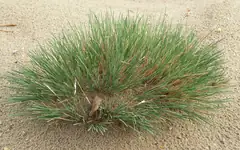 Clublawn GrassCorynephorus canescensnot rated, Central Valleyno Central Valley rating
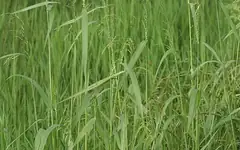 Golden Wood MilletMilium effusumnot rated, Central Valleyno Central Valley rating
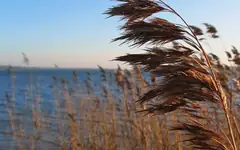 Common ReedPhragmites australisnot rated, Central Valleyno Central Valley rating
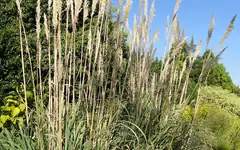 Plume GrassSaccharum ravennae (Erianthus ravennae)not rated, Central Valleyno Central Valley rating
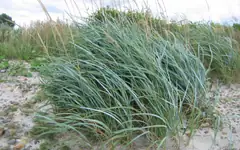 Sand RyegrassLeymus arenariusnot rated, Central Valleyno Central Valley rating
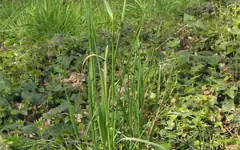 Golden Meadow FoxtailAlopecurus pratensis 'Aureus'not rated, Central Valleyno Central Valley rating
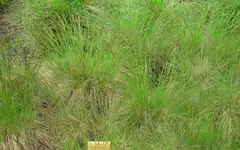 Tufted FescueFestuca amethystinanot rated, Central Valleyno Central Valley rating
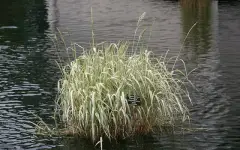 Variegated Water GrassGlyceria maxima 'Variegata'not rated, Central Valleyno Central Valley rating
Turn this into minutes on your water days
Every city page has a calculator that takes blue hair grass, your sprinkler type and the month, and gives the minutes per water day for that supplier's schedule. Or put it in a zone of the personal watering plan and get all twelve months printed.
Questions people ask
How much should I water blue hair grass in summer?
In July, established blue hair grass needs about 1.4 gallons on the south coast and 1.8 gallons in the South Inland zone each week, for a plant 2 feet across. Water deeply and let the top of the soil dry before the next watering. Skip a watering after a soaking rain.
How much water does blue hair grass need per day?
In July on the north-central coast, established blue hair grass needs about 0.2 gallons a day for a plant 2 feet across and about 0.7 gallons a day for a plant 4 feet across. Give it in deep waterings spread days apart rather than a little every day, so the whole root zone gets wet.
Does watering for blue hair grass change across California?
Yes. WUCOLS rates blue hair grass separately for each of the six California climate zones: moderate water in the North-Central Coastal zone, not evaluated in the Central Valley zone, moderate water in the South Coastal zone, moderate water in the South Inland zone, not evaluated in the High and Intermediate Desert zone, not evaluated in the Low Desert zone. The monthly table above shows how the same rating translates into different gallon amounts as reference evapotranspiration changes.
Why does blue hair grass fade in summer?
As a cool-season grass, it slows and can partly rest through hot weather. Growth resumes as it cools. Do not overwater during the pause.
When should I cut back blue hair grass?
Shear it down in early spring, just before fresh blades emerge. That clears out old blades. Water lightly as new growth starts.
Can blue hair grass grow in clay?
No, it is intolerant of clay and wet soils. Plant it in sandy, well-drained ground or a raised bed. Gravel mulch helps.
How long does blue hair grass live?
It is a short-lived perennial. Divide clumps in spring or sow new seed. Expect to refresh plantings every few years.
Can blue hair grass grow in shade?
No, it is shade intolerant and needs full sun. It does poorly in shade. Pick an open, sunny spot.
More plant watering guides
Sources
- WUCOLS IV plant water use classification for Koeleria glauca, the University of California survey California agencies use for landscape plan reviewRead August 23, 2026 on wucols.ucdavis.edu
- Model Water Efficient Landscape Ordinance, adopted text and appendices, effective 2025-01-02 · monthly reference evapotranspiration per city, Appendix CRead August 23, 2026 on water.ca.gov/-/media/DWR-Website/Web-Pages/Programs/Water-Use-And-Efficiency/MWELO-Rulemaking/Final-MWELO-Text-and-Appendices_20250103.pdf
- UC Statewide IPM Program, irrigation scheduling using evapotranspirationRead September 30, 2026 on ipm.ucanr.edu/PMG/GARDEN/ENVIRON/evap.html
- Shaw and Pittenger, Landscape Irrigation System Evaluation and Management, UC Cooperative Extension, 2009Read September 30, 2026 on ucanr.edu/sites/default/files/2013-02/160836.pdf
- Pittenger, Water Management in Gardens and Landscapes, UC Riverside, 2017Read September 30, 2026 on ucanr.edu/sites/default/files/2017-03/258022.pdf