How often to water Palmer agave in California
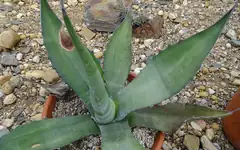
In July in the Central Valley, established Palmer agave needs about 0.2 gallons a week for a plant 2 feet across. Palmer agave is a large succulent from dry, rocky slopes in southern Arizona, New Mexico and Sonora. Its rosette of stiff, sword-like, spine-tipped leaves has a bluish cast and can reach about 4 feet tall. It grows easily on very little water once rooted. Lean, rocky ground that dries quickly suits it far better than rich, damp soil.
How often to water Palmer agave, month by month
Type your city above and the days between waterings and the gallons appear here, worked out from your city's climate table. Or read the figures by climate zone further down.
How this is worked out: the plant’s WUCOLS rating times your city’s climate for the month, over the area the plant covers. Skip a watering after a good soaking rain.
How to tell it needs water
- In the first summer after planting, soil dry well below the surface at the root ball edge calls for a slow, deep soak
- Soil still moist a few inches down means hold off, since Palmer agave comes from dry, rocky slopes
- Greasy-looking streaks on the inner face of the leaves, with yellowing near the core, point to agave mites rather than a watering problem
- A rosette that slumps and softens at the base over ground that stays wet suggests rot from poor drainage
- A thick stalk climbing toward 20 feet means the plant is making its one bloom and will die afterward, however it is watered
How to water it
- Plant Palmer agave in full sun or light part shade, in dry, rocky or gravelly soil that sheds water quickly
- Soak a new plant slowly around the root ball, then wait until the soil is dry deep down before watering again
- Once it is established, let rain carry it and add a deep soak only in an unusually long, hot drought
- Direct water onto open soil beside the rosette so it does not pool among the leaf bases
- Give the rosette a wide, clear ring of gravel or bare ground, since the leaves and the eventual stalk need room
Through the seasons
Give a new Palmer agave a few deep soaks through its first summer while its roots spread. After that it gets by on very little. It holds its leaves year round. A mature plant sends up a stalk branched like a candelabrum, and greenish-yellow flowers tinged with purple open from June into August. Hummingbirds and bats visit them, and then the rosette dies. Winter rain covers the cool months on the coast and in the Central Valley, so irrigation can stop there. In both deserts, an established plant still needs little water through winter. WUCOLS gives Palmer agave a very low water rating in the low desert, the high desert, South Inland, the south coast, the Central Valley and the north-central coast alike.
In pots
Palmer agave grows into a big rosette, so a pot suits it only while young or in a very large, heavy container. Fill it with gritty, fast-draining mix and keep the holes open. In summer, push a finger or probe several inches into the mix every few days, and water only when it is dry throughout. Let water run out the bottom, then tip out the saucer. In winter, water rarely and shelter the pot from long rainy spells. Nursery-grown agaves can carry agave mites, so check the inner leaves for greasy streaks before you buy.
- A year
- 1.71 gal per sq ft
- Reference
- Sacramento climate table
- Counts
- Plant need, before sprinkler losses
Monthly water need by climate zone
Palmer Agave: gallons per square foot per month, by WUCOLS climate zone
| Month | N. Coast | C. Valley | S. Coast | S. Inland | Hi Desert | Lo Desert |
|---|---|---|---|---|---|---|
| Jan | 0.04 | 0.04 | 0.08 | 0.08 | 0.07 | 0.08 |
| Feb | 0.05 | 0.07 | 0.08 | 0.09 | 0.09 | 0.09 |
| Mar | 0.09 | 0.11 | 0.11 | 0.13 | 0.15 | 0.15 |
| Apr | 0.12 | 0.15 | 0.14 | 0.16 | 0.19 | 0.2 |
| May | 0.15 | 0.21 | 0.16 | 0.2 | 0.24 | 0.24 |
| Jun | 0.16 | 0.25 | 0.17 | 0.23 | 0.29 | 0.28 |
| Jul | 0.16 | 0.27 | 0.2 | 0.25 | 0.3 | 0.29 |
| Aug | 0.15 | 0.24 | 0.19 | 0.23 | 0.28 | 0.26 |
| Sep | 0.12 | 0.18 | 0.15 | 0.19 | 0.21 | 0.21 |
| Oct | 0.09 | 0.12 | 0.11 | 0.13 | 0.15 | 0.15 |
| Nov | 0.05 | 0.06 | 0.08 | 0.09 | 0.09 | 0.1 |
| Dec | 0.03 | 0.03 | 0.07 | 0.07 | 0.07 | 0.07 |
| Year | 1.2 | 1.71 | 1.55 | 1.84 | 2.13 | 2.11 |
How this is worked out: the WUCOLS water rating for each zone times that zone’s climate for the month. A dash means WUCOLS does not rate the plant there. The figures are what the plant uses, before sprinkler losses.
Plants with the same water needs 13
Rated very low water in the Central Valley, like Palmer agave. Plants that drink alike can share one valve and one schedule.
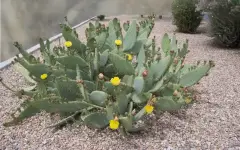 CactusOpuntia spp. & cvs. (CA natives and non-natives)very low water, Central Valley0.27 gal/sq ft in July
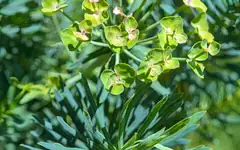 Cypress SpurgeEuphorbia cyparissiasvery low water, Central Valley0.27 gal/sq ft in July
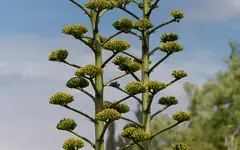 Variegated Century PlantAgave americana var. marginatavery low water, Central Valley0.27 gal/sq ft in July
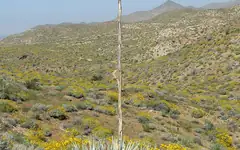 Desert AgaveAgave desertivery low water, Central Valley0.27 gal/sq ft in July
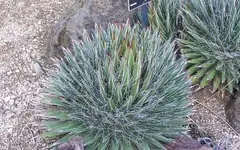 Thread Leaf AgaveAgave filiferavery low water, Central Valley0.27 gal/sq ft in July
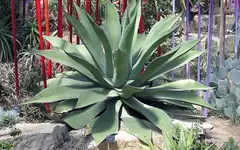 Butterfly AgaveAgave potatorumvery low water, Central Valley0.27 gal/sq ft in July
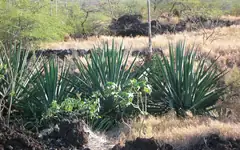 SisalAgave sisalanavery low water, Central Valley0.27 gal/sq ft in July
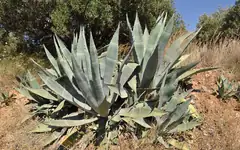 Century PlantAgave spp. & cvs.very low water, Central Valley0.27 gal/sq ft in July
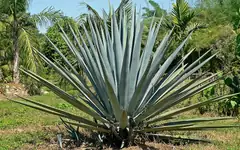 Blue AgaveAgave tequilana & ssp. & cvs.very low water, Central Valley0.27 gal/sq ft in July
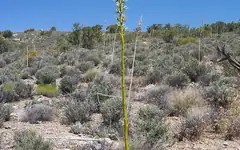 Utah AgaveAgave utahensisvery low water, Central Valley0.27 gal/sq ft in July
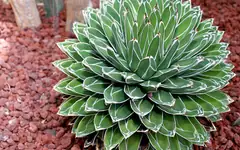 Queen Victoria AgaveAgave victoriae-reginaevery low water, Central Valley0.27 gal/sq ft in July
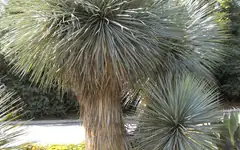 Beaked YuccaYucca rostrata ssp. & cvs.very low water, Central Valley0.27 gal/sq ft in July
 Parry's AgaveAgave parryivery low water, Central Valley0.27 gal/sq ft in July
Turn this into minutes on your water days
Every city page has a calculator that takes Palmer agave, your sprinkler type and the month, and gives the minutes per water day for that supplier's schedule. Or put it in a zone of the personal watering plan and get all twelve months printed.
Questions people ask
How much should I water Palmer agave in summer?
In July, established Palmer agave needs about 0.2 gallons in the Central Valley, 0.1 gallons on the south coast and 0.2 gallons in the South Inland zone each week, for a plant 2 feet across. Water deeply and let the top of the soil dry before the next watering. Skip a watering after a soaking rain.
How much water does Palmer agave need per day?
In July in the Central Valley, established Palmer agave needs about 0.0 gallons a day for a plant 2 feet across and about 0.1 gallons a day for a plant 4 feet across. Give it in deep waterings spread days apart rather than a little every day, so the whole root zone gets wet.
Does watering for Palmer agave change across California?
Yes. WUCOLS rates Palmer agave separately for each of the six California climate zones: very low water in the North-Central Coastal zone, very low water in the Central Valley zone, very low water in the South Coastal zone, very low water in the South Inland zone, very low water in the High and Intermediate Desert zone, very low water in the Low Desert zone. The monthly table above shows how the same rating translates into different gallon amounts as reference evapotranspiration changes.
Does Palmer agave die after blooming?
Yes. It blooms only once, and the rosette dies after flowering and setting seed. Offsets sometimes remain at the base. Dig them from the dying plant and replant them to keep it in the garden.
How tall does the Palmer agave flower stalk get?
The stalk can reach about 20 feet, topped by flower clusters arranged like a huge candelabrum. Give the plant open sky, away from eaves and overhead wires. The stalk is a sign of the end of the plant's life, not of a watering need.
What are the greasy streaks on my Palmer agave?
Thumbprint-like greasy streaks on the inner face of the leaves are the classic sign of agave mites. The mites are too small to see in the garden and hide deep in the core. Heavy infestations distort the center and can kill the plant, and watering will not fix them.
Can Palmer agave grow in part shade?
Yes, it is listed for sun or part shade. Shaded ground stays damp longer, so probe deeper before watering a plant out of full sun. Rocky, open ground is still the best match for it.
Is Palmer agave hard to grow?
No. It is considered easy to grow and somewhat frost hardy. In the wild it grows on dry, rocky, open slopes, often near oaks in canyons. Copy those conditions with fast drainage and very little water.
Does Palmer agave help wildlife?
Yes. Hummingbirds and bats visit the flowers, and woodpeckers use the tall stalks in the wild. It is also a larval host plant for the Arizona giant-skipper butterfly.
More plant watering guides
Sources
- WUCOLS IV plant water use classification for Agave palmeri, the University of California survey California agencies use for landscape plan reviewRead August 23, 2026 on wucols.ucdavis.edu
- Model Water Efficient Landscape Ordinance, adopted text and appendices, effective 2025-01-02 · monthly reference evapotranspiration per city, Appendix CRead August 23, 2026 on water.ca.gov/-/media/DWR-Website/Web-Pages/Programs/Water-Use-And-Efficiency/MWELO-Rulemaking/Final-MWELO-Text-and-Appendices_20250103.pdf
- UC Statewide IPM Program, irrigation scheduling using evapotranspirationRead September 30, 2026 on ipm.ucanr.edu/PMG/GARDEN/ENVIRON/evap.html
- Shaw and Pittenger, Landscape Irrigation System Evaluation and Management, UC Cooperative Extension, 2009Read September 30, 2026 on ucanr.edu/sites/default/files/2013-02/160836.pdf
- Pittenger, Water Management in Gardens and Landscapes, UC Riverside, 2017Read September 30, 2026 on ucanr.edu/sites/default/files/2017-03/258022.pdf