How often to water Utah agave in California
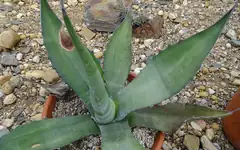
In July in the Central Valley, established Utah agave needs about 0.2 gallons a week for a plant 2 feet across. Utah agave is a small, clump-forming agave from rocky limestone slopes in California, Nevada, Arizona and Utah. Its narrow, gray-green leaves carry spiny edges and end in stout spines. Offsets slowly fill in a colony of rosettes. It is built for dry soil, and sharp drainage matters more than any watering routine.
How often to water Utah agave, month by month
Type your city above and the days between waterings and the gallons appear here, worked out from your city's climate table. Or read the figures by climate zone further down.
How this is worked out: the plant’s WUCOLS rating times your city’s climate for the month, over the area the plant covers. Skip a watering after a good soaking rain.
How to tell it needs water
- Soil still damp below the surface between Utah agave rosettes means skip watering, since it is adapted to dry, rocky ground
- On a plant set out this year, soil dry deep at the edge of the clump during summer calls for a slow soak
- Rosettes that go soft and discolored at the base in soil that stays wet suggest rot from poor drainage
- A tall, narrow spike of yellow flowers is normal for a mature rosette and is no cue to water more
How to water it
- Plant Utah agave in full sun in sandy, gravelly or rocky soil that drains fast, and do not worry about lime or alkaline ground
- Soak a new clump slowly at the root zone, then let the soil dry all the way down before the next soak
- Once it has rooted in, rely on rain and give a deep soak only during a long, hot dry spell
- Top the ground with gravel or rock chips instead of organic mulch, which holds moisture against the rosettes
- Spread water a little wider as offsets extend the colony outward
Through the seasons
Give a newly planted Utah agave a few deep soaks in its first summer, letting the soil dry between them. Once established it rarely needs irrigation. It is evergreen, and its yellow flowers rise on a narrow spike far taller than the small rosettes. In the wild it grows from desert scrub and Joshua tree woodland up into pinyon and juniper country. Winter rain covers the cool months on the coast and in the Central Valley, so irrigation can stop there. In both deserts, winter watering is rarely needed. Its WUCOLS rating is very low water statewide, from the north-central coast and the Central Valley to the south coast, South Inland, the high desert and the low desert.
In pots
Utah agave stays small, so it fits a shallow bowl or a trough with room for its offsets. Use a gritty mix in a container that drains freely. In summer heat, check the mix several inches down every few days and water only when it is dry through. Water until it flows from the holes, then empty the saucer. Keep the pot almost dry in winter and out of steady rain. Wear gloves when handling it, since the plant can irritate skin, and keep it away from pets that chew plants.
- A year
- 1.71 gal per sq ft
- Reference
- Sacramento climate table
- Counts
- Plant need, before sprinkler losses
Monthly water need by climate zone
Utah Agave: gallons per square foot per month, by WUCOLS climate zone
| Month | N. Coast | C. Valley | S. Coast | S. Inland | Hi Desert | Lo Desert |
|---|---|---|---|---|---|---|
| Jan | 0.04 | 0.04 | 0.08 | 0.08 | 0.07 | 0.08 |
| Feb | 0.05 | 0.07 | 0.08 | 0.09 | 0.09 | 0.09 |
| Mar | 0.09 | 0.11 | 0.11 | 0.13 | 0.15 | 0.15 |
| Apr | 0.12 | 0.15 | 0.14 | 0.16 | 0.19 | 0.2 |
| May | 0.15 | 0.21 | 0.16 | 0.2 | 0.24 | 0.24 |
| Jun | 0.16 | 0.25 | 0.17 | 0.23 | 0.29 | 0.28 |
| Jul | 0.16 | 0.27 | 0.2 | 0.25 | 0.3 | 0.29 |
| Aug | 0.15 | 0.24 | 0.19 | 0.23 | 0.28 | 0.26 |
| Sep | 0.12 | 0.18 | 0.15 | 0.19 | 0.21 | 0.21 |
| Oct | 0.09 | 0.12 | 0.11 | 0.13 | 0.15 | 0.15 |
| Nov | 0.05 | 0.06 | 0.08 | 0.09 | 0.09 | 0.1 |
| Dec | 0.03 | 0.03 | 0.07 | 0.07 | 0.07 | 0.07 |
| Year | 1.2 | 1.71 | 1.55 | 1.84 | 2.13 | 2.11 |
How this is worked out: the WUCOLS water rating for each zone times that zone’s climate for the month. A dash means WUCOLS does not rate the plant there. The figures are what the plant uses, before sprinkler losses.
Plants with the same water needs 13
Rated very low water in the Central Valley, like Utah agave. Plants that drink alike can share one valve and one schedule.
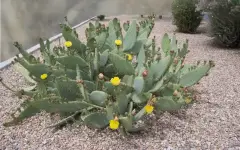 CactusOpuntia spp. & cvs. (CA natives and non-natives)very low water, Central Valley0.27 gal/sq ft in July
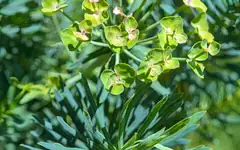 Cypress SpurgeEuphorbia cyparissiasvery low water, Central Valley0.27 gal/sq ft in July
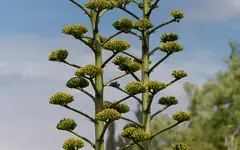 Variegated Century PlantAgave americana var. marginatavery low water, Central Valley0.27 gal/sq ft in July
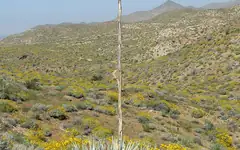 Desert AgaveAgave desertivery low water, Central Valley0.27 gal/sq ft in July
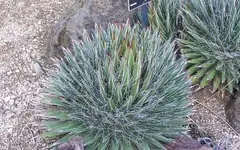 Thread Leaf AgaveAgave filiferavery low water, Central Valley0.27 gal/sq ft in July
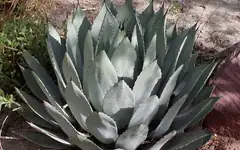 Palmer AgaveAgave palmerivery low water, Central Valley0.27 gal/sq ft in July
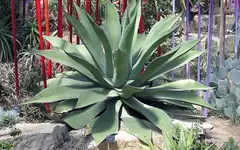 Butterfly AgaveAgave potatorumvery low water, Central Valley0.27 gal/sq ft in July
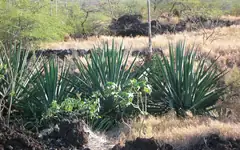 SisalAgave sisalanavery low water, Central Valley0.27 gal/sq ft in July
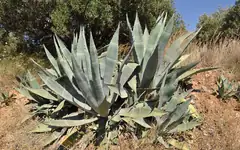 Century PlantAgave spp. & cvs.very low water, Central Valley0.27 gal/sq ft in July
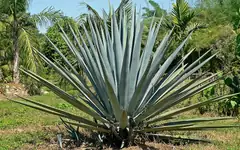 Blue AgaveAgave tequilana & ssp. & cvs.very low water, Central Valley0.27 gal/sq ft in July
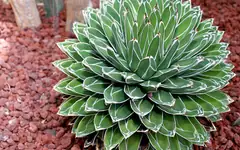 Queen Victoria AgaveAgave victoriae-reginaevery low water, Central Valley0.27 gal/sq ft in July
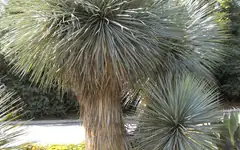 Beaked YuccaYucca rostrata ssp. & cvs.very low water, Central Valley0.27 gal/sq ft in July
 Parry's AgaveAgave parryivery low water, Central Valley0.27 gal/sq ft in July
Turn this into minutes on your water days
Every city page has a calculator that takes Utah agave, your sprinkler type and the month, and gives the minutes per water day for that supplier's schedule. Or put it in a zone of the personal watering plan and get all twelve months printed.
Questions people ask
How much should I water Utah agave in summer?
In July, established Utah agave needs about 0.2 gallons in the Central Valley, 0.1 gallons on the south coast and 0.2 gallons in the South Inland zone each week, for a plant 2 feet across. Water deeply and let the top of the soil dry before the next watering. Skip a watering after a soaking rain.
How much water does Utah agave need per day?
In July in the Central Valley, established Utah agave needs about 0.0 gallons a day for a plant 2 feet across and about 0.1 gallons a day for a plant 4 feet across. Give it in deep waterings spread days apart rather than a little every day, so the whole root zone gets wet.
Does watering for Utah agave change across California?
Yes. WUCOLS rates Utah agave separately for each of the six California climate zones: very low water in the North-Central Coastal zone, very low water in the Central Valley zone, very low water in the South Coastal zone, very low water in the South Inland zone, very low water in the High and Intermediate Desert zone, very low water in the Low Desert zone. The monthly table above shows how the same rating translates into different gallon amounts as reference evapotranspiration changes.
Is Utah agave native to California?
Yes. Its range covers California, Arizona, Nevada and Utah. In California it grows on limestone soils in the eastern Mojave Desert, around Clark Mountain.
Does Utah agave grow in alkaline soil?
Yes. In the wild it grows on rocky slopes that are generally limestone, and it tolerates high lime and alkaline soil. That makes it a fair match for many inland and desert gardens. Drainage still matters more than soil chemistry.
How do I propagate Utah agave?
Take offsets from the clump in spring or fall. Wear gloves, since the leaves are spiny and the plant can irritate skin. Water a new offset once to settle it, then let the soil dry.
Is Utah agave toxic to pets?
It is listed as harmful to dogs and cats if eaten, and as a skin irritant. Plant it where pets do not chew on plants. Wear gloves when you divide or move it.
Was Utah agave used for food?
Yes, Native Americans used it for food and as a source of mescal. Today it is grown in gardens as an ornamental. Do not try to eat a garden plant.
How big does Utah agave get?
It is a small agave, with rosettes usually under 2 feet tall that gather into clumps. The flower spike is far taller and can rise about 13 to 15 feet. Leave overhead room where a mature clump will bloom.
More plant watering guides
Sources
- WUCOLS IV plant water use classification for Agave utahensis, the University of California survey California agencies use for landscape plan reviewRead August 23, 2026 on wucols.ucdavis.edu
- Model Water Efficient Landscape Ordinance, adopted text and appendices, effective 2025-01-02 · monthly reference evapotranspiration per city, Appendix CRead August 23, 2026 on water.ca.gov/-/media/DWR-Website/Web-Pages/Programs/Water-Use-And-Efficiency/MWELO-Rulemaking/Final-MWELO-Text-and-Appendices_20250103.pdf
- UC Statewide IPM Program, irrigation scheduling using evapotranspirationRead September 30, 2026 on ipm.ucanr.edu/PMG/GARDEN/ENVIRON/evap.html
- Shaw and Pittenger, Landscape Irrigation System Evaluation and Management, UC Cooperative Extension, 2009Read September 30, 2026 on ucanr.edu/sites/default/files/2013-02/160836.pdf
- Pittenger, Water Management in Gardens and Landscapes, UC Riverside, 2017Read September 30, 2026 on ucanr.edu/sites/default/files/2017-03/258022.pdf